

Tabla de contenido
Selecting the right support method is essential for controlling roof movement, protecting underground workers, and maintaining reliable access throughout a mine’s operating life. This guide explains the main Roadway Support system types and helps mine operators compare them based on geology, loading conditions, installation requirements, equipment compatibility, and lifecycle cost.
Key takeaways:
- Roadway stability depends on geology, in-situ stress, excavation size, groundwater, mining sequence, and service life.
- Rock bolts and cable bolts reinforce the surrounding rock mass.
- Mesh, straps, and shotcrete control loose material between reinforcement points.
- Steel sets and yielding supports may be required in weak, fractured, or highly deformable ground.
- Hydraulic support provides adjustable load resistance in suitable applications.
- Squeezing or burst-prone ground usually requires an integrated support system.
- Installation speed, equipment access, inspection, and maintenance should be assessed before procurement.
- Final support designs must be based on site-specific geotechnical investigations.
What Is Roadway Support in Underground Mining?
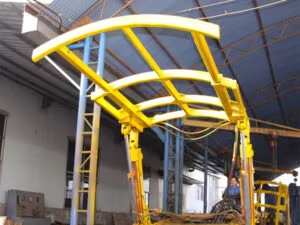
Roadway Support refers to the engineered use of reinforcement, surface-control materials, structural members, and specialized equipment to maintain the stability of underground mine openings. It is used in development headings, haulage roads, ventilation entries, crosscuts, chambers, intersections, and permanent access routes.
An effective system should respond to the expected ground failure mechanism. A roadway affected by shallow roof separation requires a different approach from one exposed to squeezing ground, high horizontal stress, dynamic loading, or water-weakened strata.
Main purposes of Roadway Support
A properly designed system helps:
- Reduce roof-fall and rib-failure risks
- Control movement around the excavation
- Protect workers and underground equipment
- Preserve the required roadway dimensions
- Maintain ventilation and emergency access
- Reduce unplanned rehabilitation work
- Support continuous mine production
Support cannot remove every geological risk. Its purpose is to control identified hazards within acceptable engineering and operational limits.
Reinforcement and external support
These two concepts are related but not identical.
Rock reinforcement
Reinforcement elements are installed inside the rock mass. Rock bolts, cable bolts, dowels, and grouted tendons help connect individual blocks or layers so that the surrounding ground can carry load more effectively.
External support
External systems act at or near the excavation boundary. Steel arches, hydraulic props, shotcrete, cribs, and frames can carry transferred loads, retain loose material, or restrict excessive roadway closure.
How Are Roadway Support Systems Classified?
Support systems can be classified according to how they resist movement, where they act, and when their resistance develops.
Active Roadway Support
Active support applies an initial force to the rock or begins controlling movement shortly after installation. Tensioned rock bolts, prestressed cable bolts, and some hydraulic systems are typical examples.
Early loading can help clamp discontinuities and restrict layer separation. The result depends on anchorage quality, installation accuracy, and the amount of applied preload.
Passive Roadway Support
Passive support develops resistance after the ground begins to move or transfer load onto the support. Steel sets, untensioned reinforcement, mesh, and certain standing supports may function primarily in this way.
A passive system needs suitable load-displacement behavior. If it develops resistance too late, excessive deformation may occur before the support becomes fully effective.
Internal reinforcement
Internal reinforcement is installed in drilled holes within the roof or ribs. It strengthens the rock structure without occupying much roadway space.
Bolt length, diameter, spacing, anchorage, installation angle, and corrosion protection must be selected according to the depth and type of the expected failure zone.
Surface and standing support
Surface support retains material at the excavation boundary, while standing support transfers loads between the roof and floor. Mesh, straps, shotcrete, steel sets, timber cribs, and hydraulic props fall into these categories.
Many mining roadways require both internal reinforcement and surface control. The reinforcement stabilizes the larger rock structure, while the surface system controls smaller loose pieces and localized loading.
Main Roadway Support System Types
The following support types are commonly used in underground coal and hard-rock mining. Their suitability depends on geology, stress, excavation geometry, equipment access, and roadway purpose.
1. Rock Bolt Support Systems
Rock bolts are installed in the roof or ribs to reinforce fractured, jointed, or layered rock. They may use resin cartridges, cement grout, mechanical anchors, friction, or combined anchoring mechanisms.
Bolting is widely used because it provides reinforcement without significantly reducing roadway clearance. Suitable equipos de túneles de carreteras can also coordinate excavation and bolting operations, reducing the time that freshly exposed ground remains unsupported.
Resin-anchored bolts
Resin-anchored bolts use chemical cartridges to bond the bolt to the borehole. They can develop support rapidly when the hole diameter, cartridge type, mixing time, and installation procedure are properly controlled.
Poor mixing or damaged cartridges can reduce anchorage performance. Installation parameters should therefore be verified during commissioning and routine quality checks.
Fully grouted bolts
Fully grouted bolts transfer load along a large part of their embedded length. This arrangement can distribute load more evenly and provide some protection against direct exposure to mine water and air.
Grout quality and complete borehole filling are important. Voids, contamination, or an unsuitable water-cement ratio may reduce the expected performance.
Friction bolts
Friction bolts generate resistance through contact with the borehole wall. They can offer rapid installation and immediate support under suitable rock conditions.
Their performance depends strongly on borehole diameter, rock strength, and installation quality. They may not be appropriate where the borehole enlarges or deteriorates quickly.
Typical rock bolt applications
Rock bolts are often suitable for development entries, bedded roofs, blocky rock, and roadways with relatively shallow instability. They are commonly combined with mesh, straps, or shotcrete instead of being used alone.
2. Cable Bolt Support
Cable bolts are longer reinforcement elements designed to extend beyond shallow fractured or separated zones. They are frequently used in wide excavations, intersections, chambers, and areas where potential instability extends deeper into the rock mass.
Cable design involves more than selecting length. Borehole orientation, grout quality, bond length, plate configuration, pretension, cable capacity, and installation equipment all affect the final result.
Rock bolts versus cable bolts
Rock bolts are generally shorter and are commonly used to control shallow roof or rib instability. Cable bolts extend reinforcement deeper and can be suitable for larger openings or deeper potential failure zones.
Longer reinforcement is not automatically safer. The cable must reach an effective anchorage zone, and its behavior must be compatible with the surrounding bolts, plates, mesh, and surface support.
3. Mesh and Strap Support
Mesh is installed across the roof or ribs to retain small rock fragments between bolts. Welded wire mesh and flexible mesh have different handling characteristics, strength, stiffness, and deformation capacity.
Steel straps connect multiple reinforcement points and distribute load across weak layers or fractured sections. Mesh and straps mainly provide surface control and should not be treated as replacements for correctly designed internal reinforcement.
Why surface control is important
Major roof blocks may be reinforced while smaller fragments remain loose between bolt plates. Mesh creates a more continuous retaining surface and reduces the likelihood of localized rockfall onto workers, vehicles, or utilities.
Welded mesh versus flexible mesh
Welded mesh is relatively stiff and can provide a regular installation surface. Flexible mesh may accommodate more irregular profiles or movement, but installation and load-transfer behavior must be evaluated carefully.
4. Shotcrete Support Systems
Shotcrete is pneumatically applied concrete that forms a continuous layer over the excavation surface. It can seal fractured rock, retain loose material, and distribute loads between reinforcement points.
El American Shotcrete Association explains that shotcrete is suitable for early ground support in mining and tunneling because it conforms to irregular excavation profiles without conventional formwork.
Plain shotcrete
Plain shotcrete can seal the surface and restrain small loose fragments. Its structural contribution may be limited where substantial cracking or deformation is expected.
Fiber-reinforced shotcrete
Steel or synthetic fibers improve toughness and post-cracking behavior. Fiber-reinforced shotcrete can therefore maintain greater residual capacity after cracking than an equivalent plain layer.
Shotcrete with bolts and mesh
An integrated system allows bolts to reinforce the rock mass while mesh and shotcrete control the excavation surface. This combination may offer more reliable performance than relying on a thin sprayed layer alone.
Suitable applications
Shotcrete is frequently considered for permanent roadways, crusher chambers, shaft stations, intersections, highly fractured rock, and openings with irregular surfaces. Material quality, thickness, curing conditions, rebound, and substrate preparation all require control.
5. Steel Sets and Arch Supports
Steel sets form a structural frame around the roadway profile. Common arrangements include arches, ribs, beams, open sets, and closed frames.
They may be used in weak ground, fault zones, rehabilitation projects, or roadways where expected loading cannot be managed by shallow reinforcement alone. Lagging, blocking, or backfilling may be necessary to transfer loads effectively between the rock and the steel structure.
Rigid steel arches
Rigid arches are intended to preserve roadway geometry under controlled loading and limited movement. If actual convergence exceeds their deformation capacity, connections may fail or structural members may buckle.
Yielding steel arches
Yielding arches use sliding or deformable connections to accommodate controlled convergence while maintaining resistance. They may be appropriate for squeezing ground when the yielding range matches the expected roadway movement.
Ventajas y limitaciones
Steel sets provide visible structural support and can carry significant loads. However, they are relatively heavy, occupy roadway space, and may require more labor and material-handling equipment than bolted systems.
6. Hydraulic Props and Powered Support
Hydraulic props apply a controllable force between the roof and floor. Individual units may be used for temporary support, localized reinforcement, repair work, intersections, or particular coal mining operations.
Powered support systems are more commonly associated with mechanized extraction faces. However, hydraulic support principles may also be applied in roadways and temporary work zones where adjustable resistance is needed.
Main hydraulic support parameters
Buyers should evaluate:
- Initial setting load
- Rated working resistance
- Yield behavior
- Available stroke
- Roof and floor contact area
- Floor bearing capacity
- Stability under inclined loading
- Hydraulic safety features
- Seal and cylinder durability
Advantages of hydraulic support
Hydraulic systems can provide defined resistance and may be reset or adjusted as conditions change. Some units can also be monitored to support maintenance and ground-control decisions.
Operational limitations
Hydraulic equipment requires suitable clearance, stable roof-floor contact, trained operators, and regular maintenance. Leakage, damaged seals, unstable foundations, or incorrect setting pressure can reduce its effectiveness.
7. Timber Props and Crib Support
Timber props, packs, and cribs are still used for temporary work, local repairs, or operations where timber support is part of an established procedure. Timber can be shaped underground and may provide visible signs of loading through deformation.
However, timber quality is variable. Moisture sensitivity, fire exposure, labor requirements, limited reuse, and inconsistent strength can make engineered alternatives more suitable for modern high-production roadways.
Crib support
A crib consists of stacked structural members that form a standing support between the roof and floor. Its load capacity and stiffness depend on the material, geometry, contact area, and construction quality.
8. Yielding and Energy-Absorbing Support
Yielding support is designed to maintain useful resistance while allowing controlled displacement. Examples include yielding bolts, deformable steel arches, energy-absorbing tendons, and specially designed connections.
This approach can be relevant where substantial convergence or dynamic loading is expected. The system must have sufficient displacement or energy capacity without losing its retaining function too early.
Support for squeezing ground
Squeezing ground may continue deforming after excavation. A system that is too rigid can become overloaded, while one that is too flexible may permit unacceptable loss of roadway clearance.
Support for dynamic loading
In burst-prone conditions, static capacity alone may be insufficient. Bolts, plates, mesh, connections, and surface support should work together under rapid loading according to a specialist dynamic ground assessment.
Roadway Support System Comparison
The following table provides a preliminary comparison for project planning and purchasing. It should not replace a site-specific engineering design.
| Support type | Primary function | Main advantages | Important limitations | Common applications |
|---|---|---|---|---|
| Pernos de roca | Reinforce the rock mass | Compact, adaptable, and suitable for mechanized installation | Performance depends on drilling and anchorage quality | Development headings and mine entries |
| Cable bolts | Reinforce deeper ground | Suitable for deeper anchorage and wide openings | Requires effective grouting and specialized installation | Intersections, chambers, and deep failure zones |
| Mesh and straps | Control surface material | Continuous coverage and compatibility with bolts | Cannot stabilize deep failure independently | Roof and rib surface control |
| Shotcrete | Confine and seal the surface | Continuous layer that follows irregular profiles | Requires material and application quality control | Permanent entries, stations, and fractured rock |
| Steel sets | Carry external ground loads | High structural capacity and visible support | Heavy, space-consuming, and labor-intensive | Weak zones, rehabilitation, and squeezing ground |
| Hydraulic props | Provide adjustable standing support | Controllable load and possible reuse | Requires maintenance and reliable roof-floor contact | Temporary work and localized heavy loading |
| Timber and cribs | Provide standing resistance | Adaptable and relatively simple to install | Variable quality and higher manual handling | Temporary support and local repairs |
| Yielding support | Accommodate controlled movement | Suitable for convergence or higher energy demand | Must be matched to expected displacement | High-stress and deforming ground |
How to Choose the Right Roadway Support
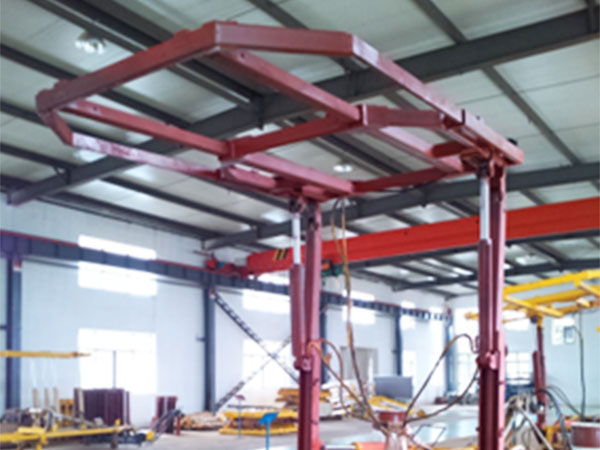
The correct system should be selected according to expected ground behavior rather than product preference alone. Procurement should begin after the mine has defined its geotechnical, production, safety, and equipment requirements.
Evaluate the rock mass
The assessment should examine lithology, bedding, joints, faults, weathering, rock strength, groundwater, and discontinuity orientation. Core logging, roadway mapping, borehole data, and previous ground-performance records can help identify likely failure mechanisms.
Roof condition
Weak interfaces, layer separation, loose blocks, and moisture-sensitive bands can affect bolt length, anchorage position, and surface-control requirements.
Rib condition
Mine ribs may spall, slab, or deform even when the roof appears stable. Rib reinforcement should therefore be evaluated separately rather than treated as a simple continuation of the roof pattern.
Floor condition
A weak or heaving floor can undermine arches, cribs, and hydraulic props. Footing area, punching resistance, drainage, and possible floor reinforcement should be considered.
Analyze stress and deformation
Depth, horizontal stress, adjacent excavations, panel layout, mining sequence, and abutment loading can change the forces acting on a roadway. The selected system requires adequate strength and compatible deformation capacity.
Conditions can also change over time. An entry that remains stable during development may experience greater convergence as nearby extraction progresses.
Define the required service life
Temporary roadways
Short-life openings may prioritize rapid installation, mobility, and recoverability. Temporary use does not remove the need to meet the mine’s safety and performance requirements.
Permanent roadways
Main haulages, ventilation entries, pump stations, and access routes normally require greater durability. Corrosion, mine water, long-term convergence, inspection access, and rehabilitation difficulty become more important.
Assess installation compatibility
A suitable component can still perform poorly if the available machinery cannot install it correctly. Check drilling height, roadway width, machine turning radius, hole depth, bolt handling, ventilation, power supply, dust control, and material transport.
YMHB Mining’s auxiliary transportation equipment can be considered when planning the movement of support materials, tools, and installation equipment through confined mine roadways.
Mechanized Roadway Support Equipment
Mechanization can reduce manual handling, standardize installation, and shorten the time that newly excavated ground remains unsupported. The equipment must still be matched to the actual roadway profile and support procedure.
Bolting rigs
Bolting rigs drill holes and install roof or rib reinforcement from a protected operating position. Buyers should compare drill coverage, feed length, boom movement, control system, drilling speed, dust suppression, and compatibility with the selected reinforcement.
Questions to ask before purchasing
- Can the rig reach every required bolt position?
- What bolt lengths and diameters can it install?
- Is it compatible with resin, grout, or friction bolts?
- Can it operate within the available roadway height?
- How easily can wear parts and drilling tools be replaced?
- What operator protection and interlocks are included?
Bolter miners
A bolter miner combines cutting and support-related functions in one operating system. Coordinating excavation and reinforcement can improve development continuity and reduce equipment changes at the heading.
Selection should reflect seam height, rock properties, roadway dimensions, production targets, transport restrictions, and the required installation sequence.
Anchor transporters and transfer units
Support productivity also depends on delivering bolts, cables, mesh, resin, grout, and tools to the working area. Dedicated handling and transfer equipment can reduce delays and unnecessary manual lifting.
Buyers can review YMHB Mining’s complete range of underground mining equipment for roadway excavation, material transport, support installation, and mine maintenance applications.
Common Roadway Support Selection Mistakes
Support problems are not always caused by inadequate component capacity. They can also result from incorrect assumptions, poor installation, incompatible elements, or insufficient monitoring.
Selecting support only by unit price
The lowest-priced component may create higher operating costs through slow installation, more rehabilitation, reduced development rates, or a shorter service life. Buyers should compare installed cost and lifecycle performance.
Copying a support pattern from another mine
Two roadways with similar dimensions can behave differently because of stress orientation, bedding, faults, groundwater, or mining sequence. A design used elsewhere can provide a reference, but it should not replace local engineering assessment.
Ignoring system compatibility
A high-capacity bolt cannot compensate for weak plates, unsuitable mesh, poor grout, or inadequate connections. Every component should form part of a compatible load-transfer system.
Focusing only on maximum load
Maximum capacity is only one performance parameter. Stiffness, displacement capacity, energy absorption, activation behavior, corrosion resistance, and installation quality can be equally important.
Overlooking installation quality
Incorrect hole diameter, insufficient resin mixing, incomplete grouting, damaged threads, loose plates, or poor hydraulic setting can prevent a well-designed system from achieving its expected performance.
Neglecting maintenance access
Conveyors, pipes, cables, and ventilation structures can block access to supported surfaces. The roadway layout should allow important areas to be inspected and repaired throughout their operating life.
Roadway Support Quality Checks for Buyers
Before ordering equipment or support components, buyers should request clear technical documentation and verify that the proposed solution matches the mine’s actual conditions.
Review component documentation
Check:
- Material specifications
- Product dimensions and tolerances
- Rated load or resistance
- Applicable test methods
- Corrosion protection
- Hydraulic ratings
- Connection details
- Quality-control procedures
- Storage and installation requirements
Performance data should identify how the component was tested. Unsupported maximum-load claims provide limited value for engineering comparison.
Confirm equipment compatibility
Verify that the drilling or bolting machine can install the required bolt length, diameter, anchoring medium, plate, mesh, and strap configuration. Consumable and equipment interfaces should be confirmed before production and shipment.
Arrange installation trials
Where appropriate, controlled trials can verify drilling time, hole quality, resin mixing, grout placement, installation access, and hydraulic setting pressure. Pull tests or other verification methods should follow the mine’s approved engineering procedure.
Evaluate supplier capability
Buyers should assess manufacturing control, technical communication, spare-parts supply, commissioning assistance, operator training, and the supplier’s ability to respond to site-specific conditions.
YMHB Mining provides technical support and mining solutions for projects requiring equipment selection, operating-condition analysis, and application matching.
Roadway Support Inspection and Monitoring
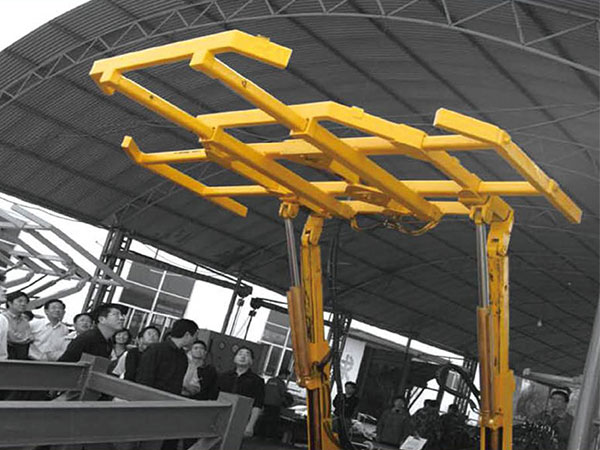
Support performance should be checked throughout the service life of the roadway. Monitoring helps determine whether actual conditions remain within predicted limits.
Visual inspection
Inspectors should check for:
- Deformed or damaged mesh
- Loose plates and nuts
- Cracked or detached shotcrete
- Buckled steel arches
- Leaking hydraulic props
- Roof cutters
- Rib spalling
- Floor heave
- Water-related deterioration
- Changes in roadway clearance
Observations should be recorded consistently so that changes can be tracked over time.
Instrumented monitoring
Convergence stations, extensometers, telltales, load cells, pressure sensors, and digital mapping systems can provide quantitative information about ground and support behavior.
Instrumentation should be selected according to the expected failure mechanism. Collecting data without defined interpretation criteria provides limited practical value.
Trigger action response plans
A trigger action response plan establishes normal, warning, and critical conditions. It should define who evaluates the results, which additional controls are required, and when access must be restricted.
Where corrective work is required, specialized lane maintenance equipment can assist with roadway repair, scaling, material handling, and rehabilitation.
Conclusión
No single Roadway Support type is suitable for every underground mine. Rock bolts and cable bolts reinforce the rock mass; mesh, straps, and shotcrete control the excavation surface; steel sets and props provide external resistance; and yielding or energy-absorbing systems address more demanding deformation conditions.
The most reliable solution is usually an integrated system selected around a clearly identified failure mechanism. Mine operators should consider geology, stress, excavation geometry, service life, installation equipment, monitoring requirements, and lifecycle cost before making a purchasing decision.
YMHB Mining supplies intelligent equipment for roadway excavation, bolting, material transportation, and underground roadway maintenance. To discuss roadway dimensions, support procedures, or equipment configurations for a specific mining project, contact YMHB Mining for technical and product information.
Preguntas frecuentes
What is the most common Roadway Support system in underground mines?
Rock bolts combined with mesh are widely used because they provide both internal reinforcement and surface control without occupying excessive roadway space. However, a commonly used system is not automatically suitable for every geological condition.
What is the best support for a weak mine roof?
A weak roof may require fully grouted bolts, cable reinforcement, mesh, straps, shotcrete, steel sets, or a designed combination. The correct solution depends on weak-zone thickness, bedding, moisture, stress, and expected deformation.
Are cable bolts better than ordinary rock bolts?
Cable bolts are not universally better. They are useful when reinforcement must extend beyond a deeper failure zone or support a larger opening, while standard rock bolts may be more practical for shallow instability.
When should a mine use steel arches?
Steel arches may be considered when internal reinforcement alone cannot control expected loading or deformation. Common applications include heavily fractured zones, faults, squeezing ground, and roadway rehabilitation.
Is shotcrete enough to support a mine roadway?
Shotcrete can provide surface confinement and early support, but it is often combined with bolts, mesh, fibers, or structural members. Whether it can function independently depends on rock quality, lining thickness, material performance, and design loading.
What is the difference between active and passive support?
Active support applies force or begins controlling movement soon after installation. Passive support develops useful resistance after the surrounding ground moves against or loads the support.
How do I choose a roof bolter for my roadway?
Start with the roadway dimensions, required bolt pattern, hole depth, rock drillability, reinforcement type, power supply, machine mobility, and mine safety rules. Confirm that boom coverage matches every required installation position.
Can one Roadway Support design be used across an entire mine?
Usually not. Geological and stress conditions change across faults, intersections, panels, depths, and rock formations. Mines often establish several standard support classes with defined rules for upgrading the system.
How often should mine roadway support be inspected?
Inspection frequency should be determined by the mine’s risk assessment, regulations, roadway function, and observed rate of deformation. Actively changing or high-risk areas normally require more frequent inspections.
What information should I give a Roadway Support equipment supplier?
Provide roadway dimensions, opening height, ground conditions, bolt pattern, drilling depth, reinforcement type, gradients, power availability, transport restrictions, expected development rate, and relevant mine standards. Detailed operating information supports a more accurate equipment recommendation.
Bienvenido a ¡Shandong Yanmei Heibao Mining Equipment Co., Ltd.! Desde 2002, estamos Redefiniendo la minería con equipos inteligentes, ofreciendo soluciones más seguras, eficientes y sostenibles.
📌 Síguenos para recibir actualizaciones e información:
- Facebook: Shandong Yanmei Heibao
- YouTube: Canal Shandong Yanmei Heibao
Únase a nosotros para explorar la innovación y la excelencia en la minería.¡juntos!