

Daftar isi
Perkenalan
Moving equipment, materials, support components, tools, and personnel through an underground mine is often more complicated than extracting material at the working face. Restricted roadway dimensions, steep gradients, changing floor conditions, long transport distances, and limited maneuvering space can all reduce the efficiency of conventional ground-based vehicles.
A monorail crane provides a different approach. Instead of depending on the roadway floor, the system travels along a suspended rail installed overhead. This allows loads to move through narrow underground roadways while reducing dependence on floor quality and keeping valuable roadway space available for other mining activities.
For coal mines and other underground operations, a well-designed monorail crane system can become a central part of auxiliary transportation. It can support material movement, equipment relocation, support installation, maintenance logistics, and other tasks that directly affect mine productivity.
This guide explains how underground mining monorail systems work, their main configurations, selection criteria, safety considerations, and the factors procurement teams should evaluate before choosing a system.
What Is a Mining Monorail Crane?
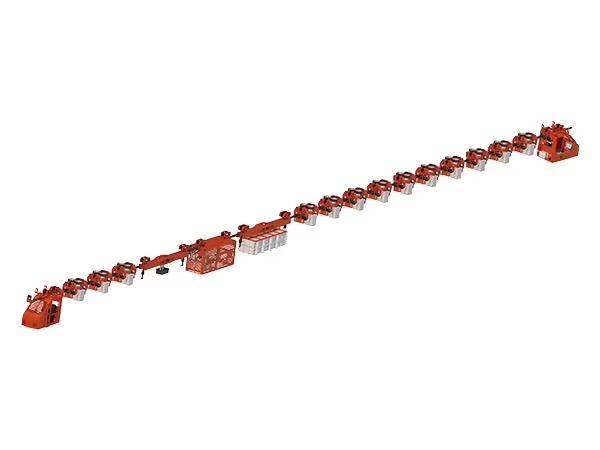
A mining monorail crane is an underground transportation system in which the vehicle or drive units travel along a suspended rail installed beneath the roadway roof.
Unlike conventional wheeled vehicles that depend heavily on roadway floor quality, a suspended monorail transfers its operating path to an overhead rail structure.
This configuration can be particularly useful where underground roadways have:
- Uneven or soft floors
- Limited width
- Frequent floor deformation
- Steep gradients
- Long transport routes
- Restricted turning space
- High demand for material and equipment transport
Mining monorail systems can be configured for different load capacities and power sources. Depending on mine requirements, operators may use battery-powered, electric, or other specialized systems.
YMHB’s range of auxiliary transportation equipment includes several monorail crane configurations designed for different underground transport conditions.
How Does an Underground Monorail Crane Work?
The basic concept is straightforward: a rail is suspended from the roadway roof, and powered drive units move along that rail.
However, a complete monorail transport system contains much more than a drive motor and a rail.
Typical components can include:
- Suspended rail sections
- Drive units
- Braking units
- Battery or electrical power systems
- Operator cabins or control stations
- Load-carrying beams
- Lifting devices
- Connecting rods
- Suspension assemblies
- Control systems
- Monitoring devices
- Emergency braking systems
The configuration depends on the required payload, roadway gradient, route geometry, transport frequency, and mine environment.
A monorail system must generate sufficient traction to move the total train mass under the most demanding operating conditions while also providing enough braking capacity to control the load safely on gradients.
For this reason, procurement teams should never evaluate a system solely by its nominal pulling force.
Why Monorail Cranes Are Used in Underground Mines
Underground transportation presents a different set of engineering challenges from surface logistics.
Roadways may be narrow, irregular, wet, or subject to floor heave. Heavy support equipment can need to travel long distances. Material supply may need to continue while excavation, bolting, ventilation, and maintenance operations occupy the same roadway.
Suspended monorail systems address several of these challenges by separating the transport path from the roadway floor.
Reduced Dependence on Floor Conditions
Ground-running vehicles rely on stable roadway surfaces.
If the floor becomes muddy, uneven, deformed, or damaged, vehicle speed and reliability may decline.
A suspended monorail is less dependent on floor quality because its travel path is supported overhead. This does not eliminate the need for roadway maintenance, but it can reduce the transport system’s sensitivity to changing floor conditions.
Better Use of Restricted Roadway Space
Underground roadways often contain:
- Conveyors
- Pipes
- Electrical cables
- Ventilation ducts
- Drainage lines
- Support structures
- Mobile machinery
A suspended transport system can make better use of the roadway cross-section by moving loads along an overhead path rather than occupying the entire floor.
Transport Across Gradients
Mine roadways frequently include inclined sections.
A properly configured monorail system can provide controlled traction and braking on gradients where conventional haulage methods may face greater limitations.
Gradient capability, however, must always be considered together with train mass, traction force, braking performance, rail condition, and load distribution.
Main Applications of Mining Monorail Crane Systems
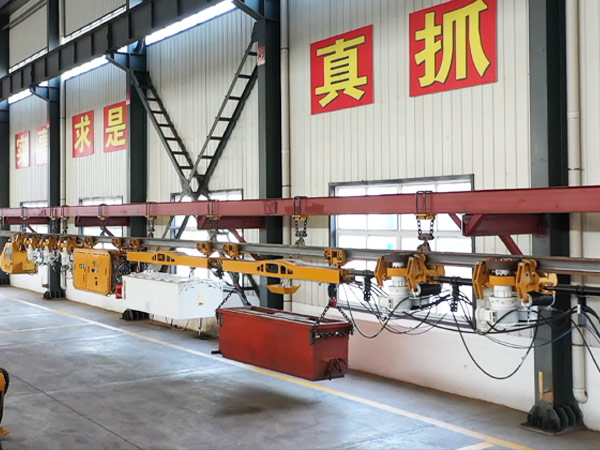
A mining monorail is not only a material carrier. Depending on configuration, it can perform several functions within the underground logistics system.
Transporting Support Materials
Roof bolts, steel arches, mesh, cables, hydraulic components, and other support materials must frequently be moved to active roadway development areas.
Efficient supply is important because excavation may stop if support materials do not reach the working section on time.
Moving Heavy Mining Components
Underground mines regularly relocate:
- Dukungan hidrolik
- Motors
- Pumps
- Electrical equipment
- Drilling components
- Conveyor parts
- Maintenance assemblies
A suitably rated monorail can help transport these components through restricted roadway environments.
Supporting Equipment Installation
Some transport systems can assist with the relocation or installation of large underground support systems.
For example, YMHB’s Derek Monorel Bertenaga Baterai Tahan Api Tipe Satu-ke-Satu offers configurations with maximum traction force reaching 360 kN, supporting applications involving heavy loads and demanding gradients.
Supplying Roadway Development Operations
Roadheader and bolting operations require continuous supplies.
A typical roadway development cycle may need:
Excavation → material removal → bolting → consumable supply → spare parts → maintenance → further excavation.
If materials arrive too slowly, even high-capacity excavation equipment cannot maintain its target advance rate.
This makes auxiliary transportation an important part of overall production planning rather than a secondary logistical task.
Main Types of Underground Monorail Cranes
Power system selection is one of the most important decisions when specifying a mining monorail.
Different mine environments may favor different approaches.
| Monorail Type | Main Advantage | Typical Consideration |
|---|---|---|
| Battery-Powered Monorail | No local combustion exhaust | Battery capacity and charging strategy |
| Monorel Listrik | Continuous electrical power | Power infrastructure and cable management |
| Monorel Baterai Tahan Api | Designed for demanding coal mine environments | Applicable certification and mine regulations |
| Heavy-Duty Monorail | High traction for large loads | Rail loading and braking requirements |
| Intelligent Monorail | Monitoring and automation potential | Control infrastructure and system integration |
There is no universally best power system. The correct choice depends on the mine.
Derek Monorel Pertambangan Bertenaga Baterai
Battery-powered underground equipment is becoming increasingly relevant because mines are seeking to reduce local emissions and dependence on diesel-powered transport.
A battery monorail can eliminate local engine exhaust during operation and may reduce some ventilation-related burdens associated with combustion-powered vehicles.
YMHB’s Derek Monorel Bertenaga Baterai Litium Seri DL is designed for auxiliary underground transportation and includes multiple traction configurations.
According to its technical specifications, the series includes models with traction forces ranging from 40 kN to 120 kN, maximum speeds of 2 m/s, and gradeability up to 25 degrees. The equipment is also designed for operation in narrow underground environments.
Battery Capacity Is Not the Only Factor
When comparing battery-powered monorail systems, procurement teams often focus heavily on battery capacity.
That is important, but actual operating endurance also depends on:
- Train mass
- Payload
- Gradient
- Travel distance
- Number of starts and stops
- Operating speed
- Ambient temperature
- Battery condition
- Regenerative capability
- Shift pattern
- Charging availability
A larger battery does not automatically guarantee higher productivity.
The key question is whether the battery system can support the required operating cycle without creating excessive charging downtime.
Electric Monorail Crane Systems
Electric monorail systems can be appropriate where reliable electrical infrastructure is already available along the transport route.
Their major advantage is reduced dependence on onboard energy storage.
However, an electric configuration may require greater attention to:
- Power distribution
- Cable routing
- Electrical protection
- Route length
- Infrastructure installation
- Mine voltage
- Explosion-protection requirements
- Maintenance of electrical components
YMHB includes the Derek Monorel Listrik DDD30 within its auxiliary transportation equipment portfolio.
Whether electric or battery technology is preferable depends primarily on the operating route and mine infrastructure rather than on one technology being universally superior.
Battery vs Electric Mining Monorail
A simple comparison can help clarify the decision.
| Faktor | Battery Monorail | Monorel Listrik |
| Route flexibility | Tinggi | Depends on electrical infrastructure |
| Onboard energy storage | Required | Usually lower dependence |
| Charging required | Ya | No battery charging cycle for traction |
| Cable infrastructure | Berkurang | Usually required |
| Local exhaust emissions | None during electric operation | None during electric operation |
| Long continuous operation | Depends on battery strategy | Can suit fixed powered routes |
| Infrastructure planning | Charging system | Electrical supply system |
| Best fit | Flexible routes and battery-supported operations | Established powered transport routes |
The final choice should be based on total operating cost and mining conditions.
Monorail Crane vs Ground-Based Underground Vehicles
Monorails and ground-running vehicles solve different transport problems.
Neither system should automatically replace the other.
Ground-Based Vehicles
These can provide flexible movement where adequate roadway width and floor conditions are available.
They may work well when:
- Routes change frequently
- Floor conditions are stable
- Wide turning areas are available
- Track infrastructure is undesirable
- Flexible point-to-point movement is required
Monorail Systems
Monorails can be attractive when:
- Roadways are narrow
- Floor conditions are poor
- Long fixed routes exist
- Loads are heavy
- Gradients are significant
- Overhead transportation improves traffic organization
Many mines may benefit from combining multiple transportation methods instead of relying entirely on one system.
Important Parameters When Selecting a Monorail Crane
A monorail system should be selected from project data rather than model brochures alone.
Traction Force
Traction force determines how much pulling capability the system can deliver.
Required traction depends on:
- Train weight
- Payload
- Gradient
- Rolling resistance
- Acceleration requirement
- Route condition
A system with insufficient traction may struggle on gradients or with heavy loads.
However, simply specifying the highest available traction force can unnecessarily increase equipment and infrastructure costs.
Braking Force
Braking is especially important in inclined roadways.
Emergency braking capacity should be assessed under the maximum expected train weight and worst-case operating gradient.
Mine-specific safety regulations and equipment standards must also be considered.
Kemampuan Menanjak
A manufacturer’s maximum gradeability specification should not be treated as the only gradient criterion.
Engineers should also consider:
- Train configuration
- Payload
- Rail condition
- Braking reserve
- Operating direction
- Curve location
- Route transitions
The maximum rated grade may not always represent the most economical continuous operating condition.
Turning Radius
Underground routes rarely remain straight.
Horizontal and vertical turning radii determine whether the system can safely pass curves, intersections, rises, and dips.
The DL-Series, for example, lists a horizontal turning radius of 4 m and vertical turning radius of 10 m across several configurations.
These dimensions need to be checked against the actual mine route before equipment selection.
Payload
Payload requirements should be defined by the heaviest realistic transport task.
Examples may include:
- Roof support equipment
- Conveyor components
- Electrical equipment
- Drilling machinery
- Structural steel
- Maintenance assemblies
The full train mass must then be calculated rather than considering payload independently.
Why Route Design Matters
A monorail crane cannot perform well if the rail route is poorly designed.
Before selecting equipment, mine planners should evaluate the complete transport path.
Important route information includes:
- Total route length
- Maximum gradient
- Average gradient
- Horizontal curves
- Vertical curves
- Roadway intersections
- Loading points
- Unloading points
- Clearance
- Rail suspension conditions
- Potential route extensions
Route design influences both equipment performance and lifecycle costs.
For example, a mine with frequent sharp curves may require a different train configuration than a mine with long straight haulage roadways.
Rail Installation and Structural Considerations
Because a monorail is suspended overhead, rail installation becomes part of the engineering system.
The rail must support static and dynamic loads generated by:
- Vehicle mass
- Payload
- Acceleration
- Braking
- Curve forces
- Gradient forces
- Load lifting
The roadway roof and suspension arrangement must therefore be evaluated according to the mine’s engineering requirements.
Routine inspection is also essential.
Rail joints, suspension points, fasteners, braking surfaces, and structural components should form part of the mine’s preventive maintenance program.
Safety Considerations for Underground Transport
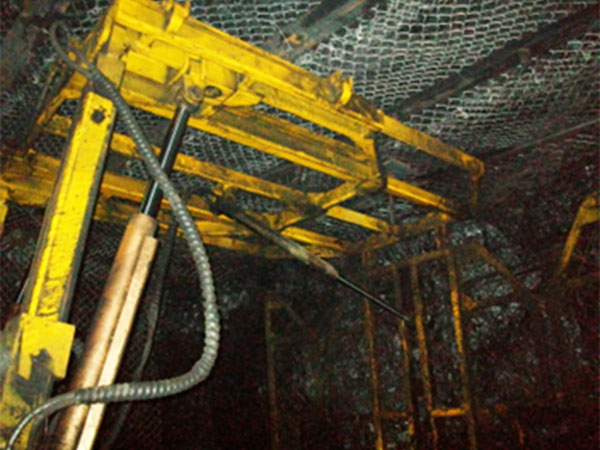
Transport safety is one of the most important reasons to evaluate the entire haulage system rather than only machine performance.
The U.S. Mine Safety and Health Administration notes in its Powered Haulage Equipment Safety Guidance that powered haulage equipment has historically been associated with a significant number of serious and fatal mining accidents.
Although specific regulations differ by jurisdiction, several principles are broadly relevant to underground transport systems.
Controlled Movement
The system should provide reliable:
- Service braking
- Emergency braking
- Speed control
- Start/stop control
- Gradient protection
- Warning systems
Clear Operating Procedures
Operators and other underground workers should understand:
- Right-of-way rules
- Loading procedures
- Exclusion zones
- Emergency procedures
- Communication signals
- Maintenance isolation procedures
MSHA haulage rules also emphasize standardized traffic rules, warning signs, adequate braking, warning devices, and sufficient clearance in mine transport areas. The agency’s mine haulage requirements provide additional context for the role of traffic management and equipment safeguards.
Load Security
Heavy loads must be properly connected and distributed.
Poor load balance can affect:
- Traction
- Braking
- Curve behavior
- Component loading
- Rail loading
Load configuration should therefore be included in operating procedures rather than left entirely to operator judgment.
Flameproof Equipment for Coal Mine Applications
Coal mines can present explosive atmospheres involving methane and coal dust.
Electrical and battery-powered equipment may therefore require specific explosion-protection designs and approvals depending on the jurisdiction where the equipment will operate.
YMHB’s Derek Monorel Tambang Bertenaga Baterai Tahan Api Seri DX is part of the company’s equipment range aimed at underground auxiliary transportation.
Procurement teams should always verify:
- Required mine certification
- Applicable electrical standards
- Battery protection design
- Motor protection
- Temperature monitoring
- Emergency isolation
- Control enclosure requirements
Certification should be discussed before finalizing equipment selection because different countries may impose different requirements.
Intelligent Control in Modern Mining Monorails
Underground transport is gradually moving toward greater digitalization and automation.
Modern systems may incorporate:
- Remote monitoring
- Operating status display
- Battery management
- Motor current monitoring
- Drive-unit coordination
- Fault alarms
- Data logging
- Remote control
- Intelligent train formation
- Unmanned driving interfaces
YMHB’s DL-Series lithium battery monorail is designed with interfaces for unmanned driving technology and intelligent marshaling, while operating functions can be monitored remotely.
Intelligent functions can provide value when they reduce specific operational problems.
For example, current monitoring can help identify abnormal motor loads before failure. Battery data can support charging planning. Position and operating status information can improve dispatch decisions.
However, automation should not be added simply because it is technologically possible.
The objective should always be measurable improvement in:
- Availability
- Keamanan
- Transport capacity
- Efisiensi energi
- Pemeliharaan
- Labor requirements
How Monorail Cranes Improve Mine Productivity
The productivity benefit of a monorail does not come only from its maximum travel speed.
The larger value is often found in reducing delays throughout the underground production cycle.
Consider a roadway development operation.
A roadheader may stop because roof bolts have not arrived.
A drilling rig may sit idle while consumables are transported manually.
Maintenance may take longer because a replacement motor cannot reach the machine quickly.
Support installation may be delayed because large components require multiple transport stages.
A well-planned monorail system can reduce these logistical interruptions.
That means transportation performance should be measured using metrics such as:
- Transport cycles per shift
- Average delivery time
- Equipment waiting time
- Tonnes transported per shift
- Availability
- Charging downtime
- Maintenance downtime
- Labor requirement
These metrics provide a more useful assessment than maximum vehicle speed alone.
How to Calculate Transport Demand Before Buying
Before requesting a monorail crane quotation, mine planners should estimate the actual logistics demand.
A useful calculation begins with expected daily transport volume.
For each material category, identify:
- Maximum individual load
- Average load
- Number of trips required
- Travel distance
- Loading time
- Unloading time
- Travel time
- Charging or power requirements
This produces a realistic duty cycle.
For example, a system may have enough pulling capacity for a heavy hydraulic support but still fail to meet production targets if loading and unloading take too long.
Transport capacity is therefore a combination of payload and cycle time.
What Information Should Be Sent to a Monorail Crane Manufacturer?
A detailed RFQ can significantly improve system selection.
Buyers should provide the following information.
Roadway Dimensions
Provide:
- Width
- Height
- Minimum clearance
- Intersection dimensions
Route Geometry
Include:
- Total route length
- Maximum gradient
- Radius putar horizontal
- Radius putar vertikal
- Loading points
- Unloading points
Load Requirements
Specify:
- Maximum payload
- Typical payload
- Component dimensions
- Transport frequency
- Whether lifting is required
Operating Conditions
Provide:
- Mine type
- Underground environment
- Number of shifts
- Daily operating hours
- Expected transport cycles
- Ambient temperature
Power Requirements
For electric equipment:
- Available voltage
- Power distribution configuration
For battery equipment:
- Required operating endurance
- Charging time available
- Charging infrastructure
Safety and Certification Requirements
Always identify:
- Country of operation
- Mine classification
- Explosion-protection requirements
- Local equipment certification requirements
This information should be provided before final model selection.
Common Mistakes When Choosing a Mining Monorail
Choosing Only by Maximum Traction Force
The strongest machine is not always the correct machine.
Excessive capacity can increase capital cost, train weight, energy consumption, and infrastructure requirements.
Ignoring the Complete Route
A monorail must negotiate every curve, gradient, loading point, and clearance restriction.
One unsuitable section can limit the entire system.
Underestimating Battery Charging
For battery-powered systems, charging strategy is part of production planning.
Buyers should calculate whether charging can occur:
- Between shifts
- During scheduled maintenance
- At intermediate stations
- Through battery replacement
Ignoring Braking Requirements
Transporting a heavy load downhill can create more demanding engineering conditions than pulling that load uphill.
Braking performance therefore deserves the same attention as traction.
Focusing Only on Purchase Price
The total cost of ownership also includes:
- Rail installation
- Power infrastructure
- Battery replacement
- Wear parts
- Pemeliharaan
- Labor
- Downtime
- Training
- Spare parts
- Route expansion
The lowest quotation may not represent the lowest cost per transport cycle.
Monorail Crane Maintenance Considerations
Preventive maintenance helps protect both availability and safety.
Maintenance programs should include inspection of:
- Drive wheels
- Brake components
- Rail joints
- Suspension points
- Electrical connections
- Battery systems
- Hydraulic components
- Couplings
- Load-carrying assemblies
- Control systems
- Emergency devices
Inspection frequency should follow manufacturer recommendations and local mining requirements.
Maintenance history should also be recorded.
A useful maintenance record links component condition with operating hours, route conditions, load history, and failure events. Over time, this information can help mines establish condition-based maintenance intervals instead of relying entirely on fixed schedules.
Where Monorails Fit Into an Integrated Mining System
Auxiliary transportation does not operate independently.
It connects directly with excavation, support, maintenance, and mine infrastructure.
For example:
Roadheader excavation → roof support → monorail material supply → drilling and bolting → equipment maintenance → continued roadway advance
If the transport system cannot match the pace of excavation and support, production becomes unbalanced.
YMHB’s underground mining solutions combine roadway excavation, intelligent bolting, auxiliary transportation, roadway support, and green mining technologies.
This system-level approach is important when a mine wants to optimize total roadway development performance rather than purchase individual machines separately.
Tanya Jawab Umum
What is a monorail crane used for in underground mining?
A mining monorail crane is mainly used to transport materials, equipment, support components, spare parts, and other heavy loads through underground roadways using a suspended rail system.
Why use a monorail instead of underground trucks?
Monorails can be advantageous where roadways are narrow, floors are uneven or unstable, gradients are significant, or fixed transport routes make suspended haulage more practical. Trucks may still offer greater route flexibility in mines with suitable roadway conditions.
Can monorail cranes operate on steep gradients?
Yes, mining monorails can be configured for inclined roadways, but actual gradeability depends on traction force, braking capacity, train mass, payload, rail condition, and equipment design.
Are battery-powered mining monorails suitable for coal mines?
Battery-powered monorails can be used in suitable underground applications, but coal mine environments may require flameproof designs and specific equipment certifications. Requirements must be checked according to local mine regulations.
What should I check before buying a mining monorail?
Important factors include maximum load, route length, roadway dimensions, gradients, turning radius, traction force, braking force, energy system, operating endurance, maintenance, and certification requirements.
How is monorail crane capacity determined?
Capacity depends on more than payload. Engineers also consider vehicle mass, number of drive units, traction force, gradient, resistance, braking performance, and the complete train configuration.
Are electric or battery monorails better?
Neither is universally better. Battery systems offer route flexibility and reduced dependence on continuous power infrastructure, while electric systems can suit fixed routes where reliable electrical supply is already available.
Can a monorail system improve roadway development productivity?
Yes. Efficient delivery of support materials, drilling consumables, spare parts, and equipment can reduce waiting time during roadway excavation and support operations. The actual productivity gain depends on how well the monorail is integrated into the mine’s production cycle.
Kesimpulan
A monorail crane system can become one of the most important components of underground auxiliary transportation, particularly where mines face narrow roadways, difficult floor conditions, long transport distances, steep gradients, or frequent movement of heavy support equipment.
Successful selection requires much more than choosing a traction rating.
Mine planners should evaluate the complete transport route, maximum and typical loads, gradients, turning radii, braking requirements, power system, operating cycle, charging strategy, certification needs, rail infrastructure, and maintenance capability.
Battery-powered and electric monorail systems each have advantages. The correct configuration is the one that delivers the required transport capacity while integrating safely and efficiently with excavation, support, maintenance, and overall mine logistics.
Explore YMHB’s complete range of auxiliary transportation equipment, including the Derek Monorel Bertenaga Baterai Litium Seri DL Dan Derek Monorel Bertenaga Baterai Tahan Api Tipe Satu-ke-Satu.
For a new underground transport project, you can also review YMHB’s integrated mining solutions and provide your roadway dimensions, route gradient, transport distance, maximum load, and operating requirements through the YMHB website to begin equipment selection.